
We assess and manage trees to keep them healthy, stable and safe. Our service combines professional visual inspection with advanced diagnostic techniques whenever they are justified.
We carry out a detailed Visual Tree Assessment (VTA) to identify possible disease, pests, structural defects and other signs of decline.
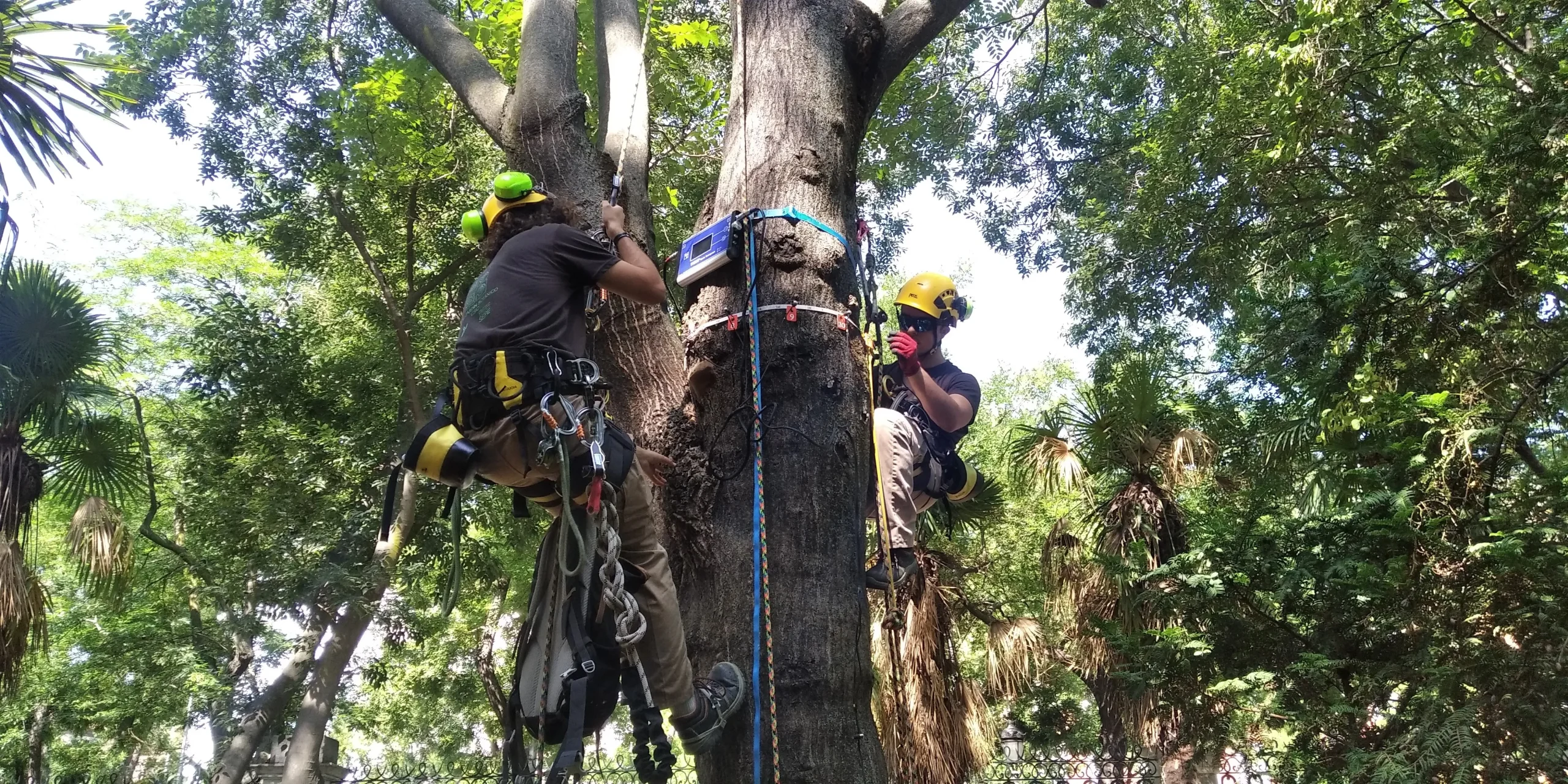
Following the initial assessment, when justified, we can use advanced diagnostic tools such as a resistance drill or sonic tomography to investigate the tree’s internal condition.
We install suitable cabling or bracing systems for trees with weakened structures. These solutions can reduce the need for large cuts while helping to manage risk.
We provide targeted treatments to prevent or control pests and diseases that may affect tree health.
Regular assessment and appropriate treatments help detect problems early and support healthy growth.
Risk inspections and correctly specified support systems help reduce the likelihood of harm from branch or whole-tree failure.
Appropriate management helps preserve tree structure, improve resilience and extend useful life.
We assess the tree and its surroundings to define the specific needs of the site.
After the initial inspection, we prepare a proportionate plan based on the tree’s condition, the targets and the client’s objectives.
We adapt the work to the needs of the tree and the property, providing clear advice throughout.
We review the results and confirm that the work has been completed in line with accepted arboricultural practice.
Where appropriate, we propose an ongoing inspection or maintenance plan to support long-term tree health.
We provide specialist arboriculture training for professionals and enthusiasts. Practical courses cover pruning, transplanting, tree health and safe working techniques, adapted to the participants’ experience.
We keep our arboricultural knowledge and working methods up to date so that every recommendation is appropriate, proportionate and beneficial.
We take time to understand your needs and provide practical advice and professional care to help keep your trees safe and healthy over time.
Pruning may be justified when a tree has dead, damaged or diseased branches, when clearance is needed around structures, or when a specific defect creates an unacceptable risk. Not every tree requires routine pruning.
The correct interval depends on the species, age, condition, location and previous management. The tree should be inspected first and pruning specified only when there is a clear objective.
Large trees can be transplanted successfully when feasibility, access, root preparation, timing and aftercare are properly planned.
Important factors include the species, age, size and health of the tree, root system, access, climate and conditions at the new site. The best timing varies by species and local climate.
We offer courses of different lengths, from one-day introductory workshops to more comprehensive training adapted to the participants’ needs and experience.
Pruning may be justified when a tree has dead, damaged or diseased branches, when clearance is needed around structures, or when a specific defect creates an unacceptable risk. Not every tree requires routine pruning.
The correct interval depends on the species, age, condition, location and previous management. The tree should be inspected first and pruning specified only when there is a clear objective.
Large trees can be transplanted successfully when feasibility, access, root preparation, timing and aftercare are properly planned.
Important factors include the species, age, size and health of the tree, root system, access, climate and conditions at the new site. The best timing varies by species and local climate.
We offer courses of different lengths, from one-day introductory workshops to more comprehensive training adapted to the participants’ needs and experience.